My blog
-
freedom
Thursday, Jan 1, 2009 6:51PM / Standard Entry
Can't believe that exactly a year ago I was in HK just wrapped the production of my film, and went straight to celebrate new year with T, Pat, Stephen and my beloved cast and crew, and a year later I'm wrapped in blankets at home nursing my cold and cough. Anyway, hope everyone had a good celebration for the new year.
Something I recently read that I think is interesting and timely to share:Freedom is central to democracy. That fact doesn't change, but the amount and type of freedom that we have does. And it feels as if it has changed dramatically in the past few years. With the Universal Declaration of Human Rights approaching its 60th birthday, Intelligent Life asked a few eminent people from different walks of life to look back over their adult lifetime and name the freedom we have gained and lost that means the most to them. They were free to take freedom in any sense, political or cultural, social or technological. What mattered was that it mattered to them.
THE SCIENTIST: RICHARD DAWKINS
Aged 67, Charles Simonyi Professor of the Public Understanding of Science at Oxford University and author of nine books, including the bestsellers "The Selfish Gene" and "The God Delusion"
FREEDOM GAINED:
Your computer mouse gives you the freedom of the world, from library to art gallery, from museum to learned journal, from online bookshop to travel timetable. Admittedly, the internet also spreads rubbish, from the trivial to the sinister. But we are free to ignore it. The net educational worth of instant worldwide information must be positive. The internet has no truck with national boundaries, and can thumb its nose at dictators and tyrannies, at priests and mullahs and all who would restrict knowledge and critical thinking.
Computer power doubles every 18 months, and its cost is declining at a similarly dramatic rate. This gives hope for worldwide enlightenment, even in those parts of the world that are still in thrall to nationalism, to tribalism, and to the vile superstitions of misogynistic desert tribesmen whose preachings arbitrarily became fossilised in influential "holy" books. Sir Tim Berners-Lee, the English physicist who, almost single-handed, invented the world wide web, has justly been awarded the Fellowship of the Royal Society and the Order of Merit. I hope for a time when he will be seen to deserve the Nobel peace prize too.
FREEDOM LOST:
We are beset by rulebooks toted by lawyers and petty bureaucrats, who worship the letter of the law and have lost the spirit of compassionate discretion. Most familiar in the infamous and despised "Health and Safety", it goes further and deeper. Time after time, we encounter horror stories of petty--and not so petty--injustices, which could so easily have been sorted out if only officials were granted the discretion to take decisions based on the spirit of goodwill and fairness, rather than on books of rules drawn up by lawyers trained to an exaggerated degree of suspicion. We hand responsibility over to the rulebook instead of shouldering it ourselves.
Doctors and nurses, teachers and professors, policemen and social workers spend their days filling in forms, which take them away from their valuable jobs. They are cowed, intimidated, lawyer-driven to cover their backs. Employers are terrified of being sued for "constructive dismissal". Teachers are terrified of showing affection or even compassion for their pupils. Travellers are terrified of making jokes to immigration officials. Rulebooks rule, and human kindness, discretion and fair play are running scared.
THE COMMENTATOR: NEAL ASCHERSON
Aged 75, expert on eastern Europe, former columnist on the Observer and the London Review of Books.
FREEDOM LOST:
Can one regret a right which damaged other people’s rights—in this case, their right to health and clean air? I was never more than an occasional smoker. Yet I still miss the compound pleasure of going to a movie in the afternoon, putting my boots on the seat in front, and lighting up a fat black Gauloise. The smoke curling up to the cupola of the almost empty cinema. The total, concentrated anticipation. The feeling that “this is the life”. With that loss went a whole grubby sensual underworld: the extinct trick of telling where a stranger came from by the perfume of his cigarettes: Ekstra-Mocny from Poland, Nazionale, Roth-Händle (this guy’s a west German left-winger), Morava from Nis which was so much sweeter than Morava from Sarajevo...
FREEDOM GAINED:
The new right for which I am most grateful has to be visa-free travel. A right still limited to certain parts of the world. But the knowledge that, within a few hours of an impulse, I can be not just in a capital city (Prague, Warsaw, Berlin) but wandering down Piotrkowska Street in Lodz , or standing on the cobbles of an East Bohemian village inhaling its scent of pork chops and cabbage, or buying the real original Weihnachtsstollen at the Christmas Fair in Dresden—that’s still miraculous. Do I regret the long waits at frontier stations, the sound of jackboots slowly moving along the corridor from compartment to compartment? No, it’s all been perfectly preserved in novels. And if you still hanker for that paranoia kick, just put on a burqa for your return journey to Britain.
THE THEOLOGIAN: TARIQ RAMADAN
Aged 45, professor of Islamic Studies at Oxford University and author of "Islam, the West and the Challenge of Modernity"
FREEDOM LOST:As we are celebrating the 60th Anniversary of the UN Declaration, one remains doubtful regarding the progress in the field of our freedoms. Sometimes it is as if we are witnessing an effective regression. For the last 20 years, and more efficiently since the attacks in the United States in 2001 and the so-called "war on terror", we have lost our right to privacy. The security policies in both America and the European Union are undermining our legitimate rights to "a protected private life": we are checked and checked again, all our details (travels, credit-card numbers, etc) are known and registered. In Britain, for instance, one may be photographed and filmed more than 300 times within a single day. We are all monitored, but some more than others.
Security measures are producing new discriminations and, with their privacy, some are losing their dignity, if not their personal integrity. The scenes one can witness in airports, especially in America, are worrying: the Arabs and the Muslims seem to have less right to freedom and to be treated with respect and in a dignified way. All these rights are interconnected and our security obsession is going as far as to accept, "for the more dangerous ones", to resort to torture which is dangerously acceptable for 53% of Americans. Scary indeed.
FREEDOM GAINED (with a condition):Is global communication a kind of standardisation? America and the European broadcast channels used to dictate the form and substance of the global news networks. During the first war in Iraq, in 1991, the American strategy had two main objectives: the battlefield and its media coverage. It was difficult to know what was really happening and it was a success. During the past decades, new private and worldwide TV and radio channels have been challenging this monolithic coverage and vision. One may be critical towards al-Jazeera and the others, but one has to acknowledge that they give another angle, a new perspective on specific issues (Palestine, Afghanistan, Iraq, Tibet, etc).
We may add to these phenomena the alternative means such as the internet where the ordinary citizen, from South America to India and all the way through Africa, can reach multiple sources of information and news. It is not an absolute gained freedom, for mainstream media remain very powerful. Nevertheless it is clear that no government, no despot and no society can dismiss the power of these alternative media. It is a freedom gained for all of us if, and only if, we take the committed decision to look for it. This kind of freedom by no means fits with passivity and laziness.
THE FORMER SPYMASTER: DAPHNE PARK
Aged 87, former British diplomat and senior MI6 officer, then principal of Somerville College, Oxford
FREEDOM LOST:
Britain helped to found the United Nations after fighting a long war against Nazi tyranny. We had to see such allies as the Poles and Czechs swallowed up by the Soviet Union. Only the temporary absence of the USSR from the United Nations, when the vote was taken on Korea in 1948, enabled us to fight and win, under United Nations auspices, the war in Korea where both the USSR and China were engaged against us. From 1945 we could not travel freely or talk to anyone behind the Iron Curtain. I felt deep anger, serving for two years in Moscow in the 1950s, because I could not talk to Russians. For them, any foreign contact meant the gulag.
In all that time the United Nations, because we failed to foresee the flaws in its constitution, and how it could be manipulated, has been powerless to intervene in the Sudan, in Myanmar, and in Zimbabwe and, because of its appalling unwieldiness, it failed to save Rwanda and was totally ineffective in Sierra Leone. Declarations which cannot be made good are worse than useless. So long as the UN's mandate is to observe but never to intervene, it raises false hopes and it colludes in the death of freedom.
In my life therefore I have seen access to freedom of speech and action denied to a wide range of brave and valuable human beings, my contemporaries in a rapidly changing world, where people and ideas are a vital resource. We have been powerless to change their situation. (The new world of the internet has made it, however, more difficult to cut any country off from free communications.) At the same time the state, in most countries, has become more powerful, and more insistent that we should accept a multicultural regime which often inhibits honest comment on the social evils which confront us.
FREEDOM GAINED:
Women matter today. They have always played a significant part in society but in the last 50 years their overt power and status has greatly increased in many, though not all, countries. They are recognised now as equal players (even in the armed forces in some countries) and certainly in the world of work.
There are important regional variations. Sharia law still effectively denies access to many of their most important rights as citizens in our society in the field of education, and in marital matters. But in general women have been accorded the more powerful voice in many societies that they deserve and that has had a significant result in the field of education, science, the media and indeed politics. Aid works best when it is given directly to women. Finally, I have known two women prime ministers, both Somervillians!
-
click daily
Tuesday, Sep 2, 2008 7:16PM / Standard Entry
http://stopglobalwarming.care2.com/
and thanks for everyone's bday wishes, that's so sweet of y'all...
-
Blog: Tuesday, Aug 19
Wednesday, Aug 20, 2008 12:27AM / Standard Entry
-
is this for real?
Thursday, Aug 14, 2008 1:59AM / Standard Entry
-
thanks to gabe & max
Friday, Jun 27, 2008 5:33PM / Standard Entry
Stats
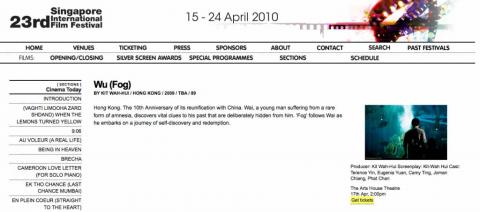
- Kit Hui was born in Hong Kong and immigrated to the United States at the age of sixteen. She received her MFA from Columbia University's Graduate Film Program...Kit Hui was born in Hong Kong and immigrated to the United States at the age of sixteen. She received her MFA from Columbia University's Graduate Film Program. Her thesis film, "missing", was selected for the official competition at the Cannes Film Festival and has screened at numerous film festivals worldwide. Her previous short film, "A Rainy Day," won the top prize at the China-American Film Festival and the Best Cinematography award at the International Student Film Festival at Buenos Aires. She is currently developing two features, an HD project "Fog" (currently in post-production) and "A Breath Away" which was selected for the Hong Kong Asian Film Financial Forum (HAF), the Sundance Writer's Lab and Director’s Lab, and the Cannes Film Festival Cinéfondation Residency in Paris.
許潔華出生於香港,十六歲時移居到美國。她從哥倫比亞大學電影系畢業,獲得碩士學位。她的畢業電影“Missing”被康城電影節選中參賽並在許多國外電影節上放映。她的上一部短片“A Rainy Day”獲得了中美國際電影節的金獎,並在布宜諾思艾利斯舉辦的國際學生電影節上得到最佳攝影獎。她現正籌備兩套長片,一部為高清電影〈霧〉,而另一部計劃〈隔離〉就參與了香港亞洲電影投資會(HAF)的電影計劃和美國太陽舞電影節的編劇及導演實驗室。許之前亦被德國柏林影展挑選參與其新秀創作營和被康城電影節選送到巴黎進修。
许洁华出生于香港,十六岁时移民到美国。她从哥伦比亚大学电影系毕业,获得硕士学位。她的毕业电影”Missing”被戛纳电影节选中参赛并在许多国外电影节上放映。她的上一部短片”A Rainy Day”获得了中美国际电影节的金奖,并在布宜诺思艾利斯举办的国际学生电影节上得到最佳摄影奖。她现正筹备两套长片,一部为高清电影〈雾〉,而另一部计划〈隔离〉就参与了香港亚洲电影投资会(HAF)的电影计划和美国圣丹斯电影节的编剧及导演实验室。许之前亦被德国柏林影展挑选参与其新秀创作营和被戛纳电影节选送到巴黎进修。 - Occupation: Director , Screenwriter
- Gender: Female
- Total visits: 69,861
User menu
alivenotdead spotlight
Dead Not Alive 萬聖節派對
Medals
-
March 20, 2008
-
March 20, 2008
-
March 20, 2008